A masterfully executed chocolate ganache is the ultimate display of confectionery fluid mechanics. Whether cast as a glassy glaze over a delicate opera cake, piped as a velvety ribbon into a tart, or rolled into an elite truffle, the ganache should manifest a completely smooth, glossy surface with a heavy, uniform flow. The instant it enters your mouth, it should offer a luxurious, coating feel that dissolves instantly, releasing its intense chocolate profile without any waxy drag, separation, or gritty sandiness.
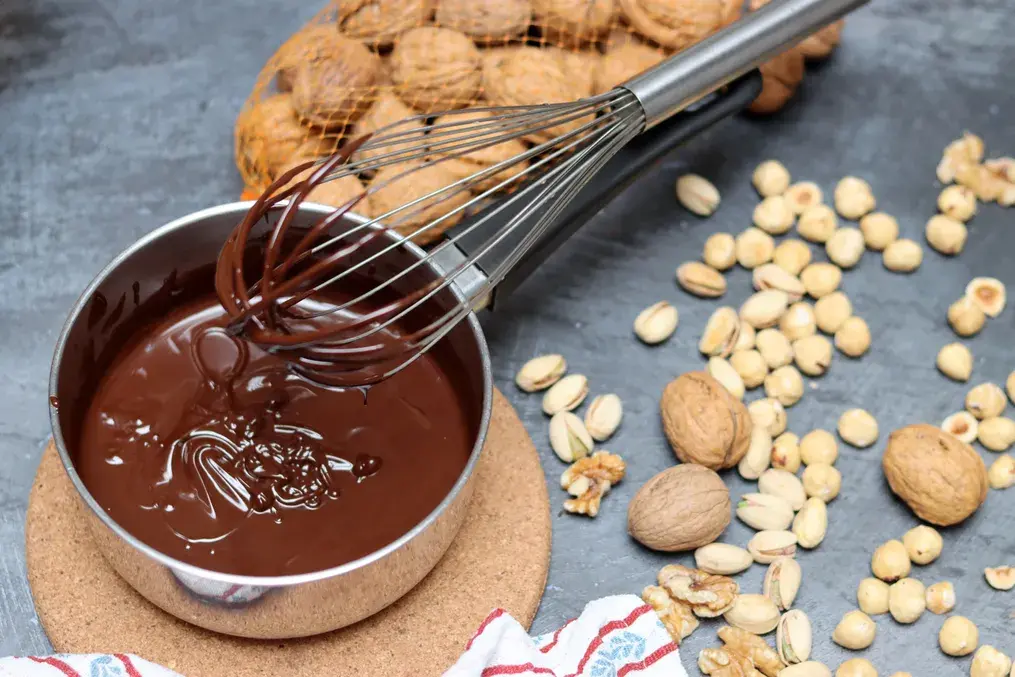
When a ganache goes wrong, it splits into a grainy, curdled mess that leaks a pool of yellow oil, or it sets into a dull, matte block that breaks like cold butter.
Many home cooks assume that a grainy ganache is simply the result of using the wrong brand of chocolate or stirring too fast. In reality, mastering the texture of this delicate chocolate cream requires navigating a precise thermodynamic balance between lipid-in-water emulsions and sugar crystallization boundaries. By understanding how to manipulate these states with inverted sugars, you can consistently engineer a flawless, mirror-like gloss and an ultra-silky mouthfeel.
The Molecular Blueprint: The Lipid-in-Water Emulsion
To control the stability and gloss of your ganache, you must look at what happens inside the bowl when hot cream meets solid chocolate. A ganache is not a simple melted liquid; it is a complex two-phase emulsion.
The Continuous Phase (The Water Base): Heavy cream is an emulsion consisting of roughly 60% water and 36% to 40% dairy fat. When heated, the water content acts as the welcoming liquid environment inside your bowl.
The Dispersed Phase (The Fat Bundles): Chocolate is packed with high volumes of natural cocoa butter fat. When melted by the hot cream, these fats break apart into billions of microscopic oil droplets.
The Emulsification Pass: To create a perfect ganache, you must force these billions of hydrophobic (water-hating) cocoa butter droplets to suspend themselves evenly throughout the water base of the cream. This requires help from natural emulsifiers like dairy casein proteins and chocolate lecithin, which wrap around the fat droplets to keep them from merging and separating.
The Sugar Inversion Performance Matrix
To control the setting capacity, moisture retention, and surface reflectivity of your chocolate cream, you can easily alter the molecular structure of your sugars:
Standard Sucrose Only (Granulated Sugar): Forms a basic, straightforward network. While it sweetens the cream, sucrose molecules naturally look for each other as they cool, leading to a dull, matte surface finish and a higher risk of turning grainy over time.
Liquid Inverted Sugar (Trimoline or Honey): Composed of split glucose and fructose molecules. It physically breaks up sucrose structures, resulting in a highly reflective, mirror-like exterior gloss and an exceptionally elastic, fudgy interior chew that resists drying out. This is the absolute requirement for professional pastry glazes.
Liquid Glucose Syrup: Packed with long, bulky dextrin chains. It provides extreme viscosity and thickness, creating an ultra-slow, clean draping flow that holds its shape beautifully on the borders of a cake without running off the plate.
1. The Sugar Inversion Advantage: Binding Moisture for Gloss
If you make a ganache using pure chocolate and heavy cream alone, the surface will dry out within 24 hours of exposure to your refrigerator's air, turning into a dull, flat skin that crackles when sliced.
The Power of Split Sugars
To achieve a permanent, mirror-like sheen, professional chocolatiers always add a splash of inverted sugar (such as trimoline, glucose, or natural honey) to the hot cream.
Standard granulated sugar is sucrose—a large double-molecule. Inverted sugar has been chemically split into two separate single sugars: glucose and fructose. Because these split sugars are highly hygroscopic (water-attracting), they bind onto the water molecules in the cream with incredible strength. This tight bond prevents the moisture from evaporating into the cold air, keeping the outer skin of the ganache permanently hydrated, soft, and hyper-reflective like liquid glass.
2. The Broken Emulsion: Preventing the Greasy Split
The single most common structural failure in a chocolate cream is a split emulsion, which causes a layer of clear yellow cocoa butter oil to leak out of the mixture during stirring.
Aggressive Whipping Disasters
This greasy separation happens because the fat-to-water ratio was thrown off balance, or because the mixture was stirred too violently while it was still boiling hot.
If you dump boiling cream over chocolate and immediately whip it with a traditional wire whisk, you introduce excessive mechanical friction and air. This friction forces the microscopic cocoa butter droplets to collide at high speed. They burst through their protective protein wrappers, merging into large pools of free oil that separate from the water entirely. To fix or prevent this, you must use a slow, concentric circular motion with a rubber spatula, or deploy a digital immersion blender beneath the liquid surface to pull the phases back into a tight, microscopic grid without introducing air.
Step-by-Step Precision Ganache Protocol
Follow this exact sequence to ensure a stable lipid emulsion and a perfect, high-gloss finish.
The Rolling Liquid Simmer: Combine your heavy cream and your inverted sugar (such as a tablespoon of liquid glucose or mild honey) in a small saucepan over medium heat. Bring the liquid to a gentle simmer until it reaches exactly 180°F (82°C)—look for tiny bubbles forming around the edges of the pot, but do not let it boil over. This temperature activates the sugars and warms the water base perfectly.
The Quiet Inoculation Rest: Place your finely chopped 60% dark chocolate callets into a heatproof glass bowl. Pour the hot cream directly over the solid chocolate, ensuring all the pieces are completely submerged beneath the liquid. Walk away and let the bowl sit completely undisturbed for 3 full minutes. This static rest allows the thermal energy of the cream to melt the solid cocoa butter crystals gently and evenly without any physical stress.
The Concentric Emulsion Stir: Insert a flexible rubber spatula straight into the dead center of the bowl. Begin stirring in tiny, tight circular motions without lifting the spatula from the bottom of the dish. Do not use a wire whisk. As you stir, a dark, shiny core will form in the middle of the bowl. Slowly widen your circles outward, pulling in the remaining pale cream until the entire mixture transforms into a thick, uniform, and hyper-glossy chocolate cream.
The Cold Butter Mount (Optional for Truffles): Let the ganache cool down to 95°F (35°C). Whisk in two pieces of room-temperature unsalted butter. The butter adds extra dairy lipids that integrate seamlessly into the warm emulsion, providing an ultra-silky mouthfeel that melts instantly at body temperature.
The Ambient Stabilization Set: Pour the warm ganache directly over your cake or into your tart shell. Let it sit undisturbed at room temperature for 2 hours to allow the cocoa butter fats to solidify into a stable crystalline structure before moving it to the refrigerator; sudden cold shocks can cause the fats to crystallize unevenly, dulling the surface gloss.
Troubleshooting Ganache Failures
Problem: The Ganache Looks Dull, Matte, and Has a Rough Texture Like Wet Sand
The Cause: You omitted the inverted sugar stabilizer, or you attempted to use a low-quality chocolate chip brand that lacked enough pure cocoa butter. The sugar molecules crystallized into large, jagged grains as they cooled. Always add a splash of glucose or honey, and stick to professional-grade couverture chocolate.
Problem: The Mixture Split into a Curdled, Grainy Mass with Yellow Oil Floating on Top
The Cause: The cream was too hot when poured, or you stirred too aggressively with a whisk, breaking the delicate lipid-in-water suspension. To rescue a split ganache, warm the bowl gently over a water bath, add exactly 1 tablespoon of room-temperature milk or water, and stir gently in tight circles from the center out to re-establish the liquid base.
Problem: The Ganache is Stiff and Hard like a Brick, Making it Impossible to Slice
The Cause: Your chocolate-to-cream ratio was too high, or you used an intense 85% dark chocolate without adjusting the liquid volume. High cocoa solid concentrations pack together into a dense physical wall when cooled. Increase the volume of heavy cream in your master formula to soften the structural grid.